
Same-Day Speed
Parts that once required days or weeks from an outside lab can now be printed in our office in as little as 30 minutes. This reduces your wait time and often eliminates the need for extra appointments.
Future-ready in-house fabrication for models, guides, and more.
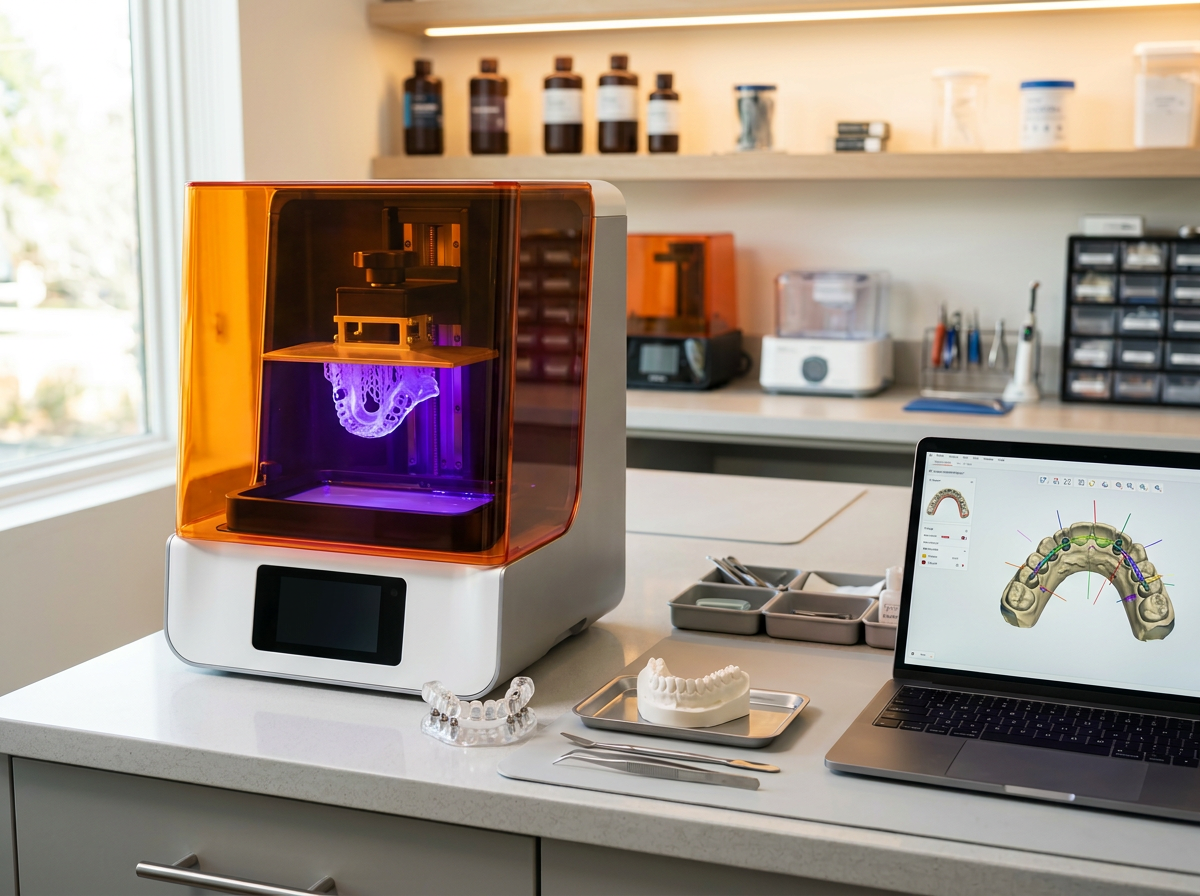
In-house 3D printing brings digital designs to life by building physical dental models, surgical guides, and custom appliances layer by layer — directly from your digital scans. This eliminates the wait for outside labs to fabricate models and guides, keeping more of your care efficient, accurate, and under one roof.
Using biocompatible, dental-grade resins, our 3D printer produces parts with exceptional detail and precision. Combined with our iTero scanner, CBCT imaging, and CAD software, 3D printing is a critical link in our fully digital workflow — from scan to screen to finished product.
How dental 3D printing works: The process starts with a digital file — typically from an iTero scan or CBCT volume. Our design software converts the file into a printable model, slicing it into hundreds of ultra-thin layers. The 3D printer then builds the part layer by layer using a UV-cured resin, with each layer measuring as thin as 50 microns (0.05 mm). After printing, the part is washed, cured under UV light, and finished for clinical use. The entire process — from digital file to finished part — can be completed in as little as 30 minutes to a few hours depending on complexity.
What we 3D print in our office: diagnostic and study models (replacing plaster casts), surgical guides for precise implant placement, orthodontic models for aligner and retainer fabrication, try-in templates for smile design and cosmetic previews, custom impression trays, temporary crowns and bridges, and occlusal splints. As 3D printing materials and technology continue to advance, we expect to expand our in-office capabilities further.
Parts that once required days or weeks from an outside lab can now be printed in our office in as little as 30 minutes. This reduces your wait time and often eliminates the need for extra appointments.
Every print is built from your unique digital scan, ensuring an exact fit. Surgical guides printed from CBCT data position implants with sub-millimeter accuracy, improving safety and outcomes.
3D printing connects directly to our iTero scanner, CBCT, and CAD software. This end-to-end digital workflow means fewer manual steps, fewer errors, and a smoother experience for you.
We start with a digital scan (iTero) and/or 3D X-ray (CBCT). These files form the foundation for whatever part we need to create.
Using specialized CAD software, we design the model, guide, or appliance on screen — verifying fit, anatomy, and treatment goals before printing.
The design file is sent to our 3D printer, which builds the part layer by layer from dental-grade resin. Printing time ranges from 30 minutes to a few hours depending on size and complexity.
The printed part is washed, UV-cured for full strength, and finished (trimmed, polished, or sterilized as needed). We verify the fit in your mouth and proceed with treatment.
Are 3D-printed dental parts safe to use in my mouth?
Yes. We use FDA-cleared, biocompatible dental resins specifically designed for oral use. Each material is tested for safety, strength, and compatibility with soft tissues. We follow the manufacturer's protocols for curing and sterilization.
How long does 3D printing take?
Print times range from about 30 minutes for a simple model to a few hours for larger or more detailed parts like surgical guides. Post-processing (washing and UV curing) adds another 15–30 minutes.
What's the difference between 3D printing and milling?
Milling carves a part from a solid block (subtractive manufacturing), while 3D printing builds a part layer by layer from liquid resin (additive manufacturing). We use milling for permanent crowns and 3D printing for models, guides, and temporary parts — each technology excels at different tasks.
Can you 3D print a permanent crown?
Current 3D-printed crown materials are best suited for temporary or provisional restorations. For permanent crowns, our in-office mill produces stronger, more durable results from solid ceramic. However, 3D printing technology is evolving rapidly.
Will 3D printing replace going to a dental lab?
For many applications like models, guides, and temporaries, yes — in-house printing is faster and more convenient. However, complex restorations, full-mouth cases, and certain prosthetics still benefit from the expertise of a skilled dental lab technician.
Is 3D printing more expensive?
Not typically. In-office printing can actually reduce costs by eliminating lab fees and shipping for models and guides. We pass those efficiencies along to our patients when possible.
How accurate are 3D-printed surgical guides?
Very. Studies show that 3D-printed surgical guides can achieve implant placement accuracy within fractions of a millimeter of the planned position. This precision improves safety by protecting nerves, sinuses, and adjacent teeth.
What materials do you use?
We use a variety of dental-grade photopolymer resins depending on the application: rigid resins for models and guides, flexible resins for certain appliances, and biocompatible resins for anything that contacts oral tissues. All materials are FDA-cleared for dental use.